
If you run paid advertising, you have probably heard people talk about ROAS, cost per click, conversion rates, impressions, and a dozen other marketing metrics.
They matter.
But one of the most important numbers for understanding whether your marketing is actually helping your business grow is customer acquisition cost, or CAC.
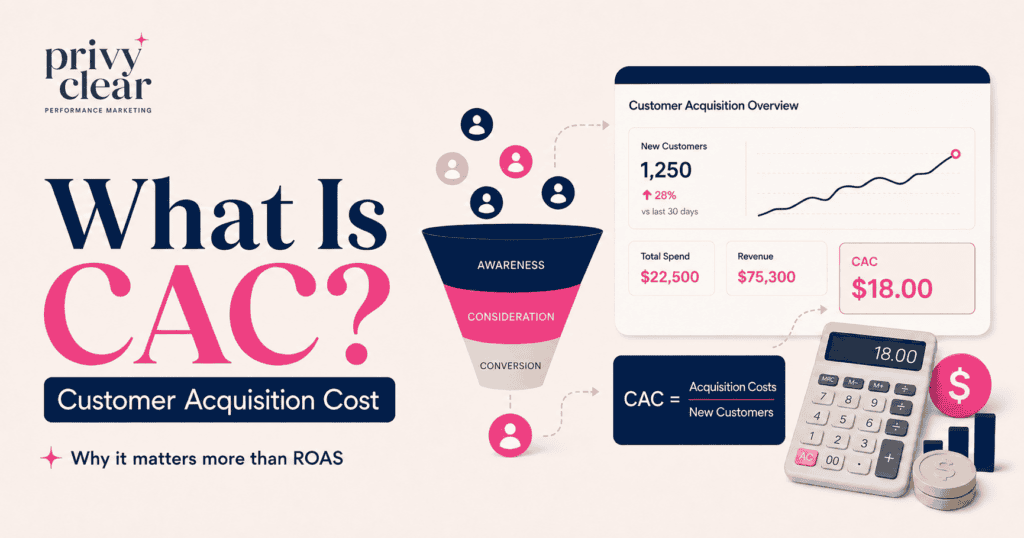
CAC tells you how much money it costs your business to acquire one new customer.
And unlike a shiny number inside Meta Ads Manager or Google Ads, CAC forces you to look at the bigger picture.
Because an ad campaign can technically have a good ROAS while the overall math of acquiring customers still sucks.
What Is Customer Acquisition Cost?
Customer acquisition cost (CAC) is the average amount your business spends to acquire one new customer.
The basic CAC formula is:
CAC = Total Customer Acquisition Costs ÷ Number of New Customers Acquired
For example:
If your business spends $10,000 on marketing and sales during a month and acquires 100 new customers, your CAC is:
$10,000 ÷ 100 = $100 CAC
You spent an average of $100 to acquire each new customer.
That number becomes much more useful when you compare it against what those customers are actually worth to your business.
What Should Be Included in Your CAC?
This is where businesses frequently screw up the calculation.
If you only include your Meta or Google advertising spend, you are not necessarily calculating your true customer acquisition cost.
Depending on your business, acquisition costs may include:
- Google Ads spend
- Meta Ads spend
- TikTok, LinkedIn, programmatic, or other paid media
- Advertising agency fees
- Marketing software
- Landing page or website costs related to acquisition
- Email or SMS marketing costs
- Sales commissions
- Sales team expenses
- Creative production
- Lead generation tools
You can calculate CAC at different levels depending on what you are trying to learn.
For example, we may calculate a paid media CAC to evaluate advertising efficiency while also looking at a broader blended CAC that includes the total cost of acquiring customers across the business.
Neither is inherently better.
They answer different questions.
Why CAC Matters
Imagine your Meta Ads account shows a 4X ROAS.
Sounds pretty damn good.
But then you dig deeper.
Your business spent $10,000 acquiring customers.
You acquired 100 new customers.
Your CAC is $100.
Now imagine the average new customer generates $80 in gross profit.
That changes the conversation considerably.
The advertising platform can still report attractive results while the business itself struggles to acquire customers profitably.
That is why we don’t like evaluating advertising in a vacuum.
The goal isn’t to make Ads Manager look good.
The goal is to make the business money.
CAC vs. ROAS: What’s the Difference?
ROAS, or return on ad spend, measures how much revenue your advertising generated compared with what you spent on ads.
The basic formula is:
ROAS = Revenue Attributed to Advertising ÷ Advertising Spend
If you spend $1,000 and generate $4,000 in attributed revenue:
$4,000 ÷ $1,000 = 4X ROAS
Useful? Absolutely.
Complete picture? No.
ROAS usually focuses specifically on advertising spend and attributed revenue.
CAC focuses on how much acquiring an actual new customer costs your business.
This becomes especially important for ecommerce companies because advertising platforms may report purchases from existing customers alongside purchases from brand-new customers.
A 5X ROAS campaign consisting heavily of repeat customers tells a different story from a 3X ROAS campaign that consistently brings new customers into the business.
You need both pieces of information.
CAC vs. CPA
CAC and CPA also get used interchangeably, but technically they measure different things.
CPA, or cost per acquisition/action, measures how much you paid for a particular conversion.
That conversion might be:
- A purchase
- A lead
- A phone call
- A form submission
- A booked appointment
- An app install
CAC specifically measures the cost of acquiring a new customer.
For an ecommerce business, your Meta CPA may tell you that purchases cost $35 each.
But if some of those purchases came from existing customers, your new customer CAC could actually be higher.
That distinction matters when you’re trying to scale.
What Is a Good Customer Acquisition Cost?
There isn’t one universal “good CAC.”
A $100 customer acquisition cost could be fantastic for one company and catastrophic for another.
You have to compare CAC against things like:
Average order value. How much does the average customer spend per order?
Gross margin. How much money do you actually keep after the direct cost of delivering the product or service?
Customer lifetime value. How much will that customer likely generate throughout their relationship with your business?
Repeat purchase rate. How often do customers come back?
Payback period. How long does it take you to recover the money spent acquiring the customer?
A business selling a $30 product that customers purchase once has very different acquisition economics from a subscription company whose average customer spends $1,500 over two years.
Context matters.
CAC and Customer Lifetime Value
This is where customer acquisition cost becomes much more powerful.
Your customer lifetime value, often shortened to LTV or CLV, estimates how much value a customer generates over the entire relationship with your business.
Imagine you spend $60 acquiring a customer.
Their first order is only $75.
At first glance, that might not look exciting.
But what if the average customer purchases four times and ultimately generates $300 in revenue?
Now your $60 CAC looks very different.
This is why ecommerce growth strategies often involve more than simply lowering advertising costs.
You can improve the economics by increasing:
- Customer retention
- Repeat purchase rate
- Average order value
- Email and SMS revenue
- Upsells
- Cross-sells
- Subscription adoption
- Customer lifetime value
Sometimes the answer isn’t “make ads cheaper.”
Sometimes the answer is “make each customer more valuable.”
Usually, it’s some combination of both.
How to Lower Customer Acquisition Cost
If your CAC is too high, immediately cutting your ad budget isn’t always the answer.
You need to figure out why acquiring customers costs too much.
Improve Your Advertising Creative
For Meta Ads in particular, creative has become one of the biggest levers available to advertisers.
Test different:
- Hooks
- Offers
- Product angles
- Images
- Videos
- Testimonials
- Problems
- Benefits
- Calls to action
Then scale the concepts that consistently produce customers.
Don’t just make more ads.
Make more variations of what is already working.
Improve Your Landing Pages
Sending more traffic to a weak website doesn’t fix anything.
If people click your ads but don’t convert, examine:
- Page speed
- Mobile experience
- Product photography
- Headlines
- Product descriptions
- Pricing
- Shipping information
- Reviews
- Calls to action
- Checkout friction
- Trust signals
A higher conversion rate means more customers from the traffic you’re already paying for.
That can lower CAC without reducing your advertising budget.
Improve Your Offer
Sometimes the marketing isn’t the problem.
The offer is.
Test:
- Free shipping thresholds
- Bundles
- Introductory discounts
- First-order offers
- Buy-more-save-more promotions
- Guarantees
- Bonuses
A better offer can dramatically change customer acquisition economics.
Improve Retargeting
Most people don’t purchase the first time they visit your website.
Strong retargeting helps bring those users back through platforms such as Google, Meta, programmatic advertising, email, and SMS.
Someone may discover your company through a Google Search ad, visit your site three times, see a Meta retargeting ad, receive an email, and finally purchase.
Modern customer acquisition rarely happens through one perfectly isolated channel.
Fix Your Tracking
Before making major decisions based on CAC, make sure your data isn’t garbage.
Your tracking setup may include:
- Google Analytics 4
- Google Tag Manager
- Meta Pixel
- Meta Conversions API
- Google Ads conversion tracking
- Shopify
- CRM data
- Call tracking
- Email and SMS platforms
Advertising decisions are only as good as the data behind them.
Don’t Optimize Marketing Metrics in Isolation
This is one of the biggest differences between running ads and actually building a growth strategy.
We care about CPC.
We care about CPA.
We care about conversion rate.
We care about ROAS.
But none of them should exist in their own little spreadsheet universe.
You have to connect advertising performance to the economics of the business.
How much did we spend?
How many new customers did we acquire?
What did those customers purchase?
What did we make after costs?
Are they coming back?
How long until we recover our acquisition cost?
Can we profitably acquire more of them?
Those questions matter a hell of a lot more than whether Meta gave your campaign a pretty green arrow this week.
The Bottom Line
Customer acquisition cost gives businesses a much clearer way to evaluate marketing and advertising performance.
The formula itself is easy:
Customer Acquisition Cost = Acquisition Costs ÷ New Customers
The hard part is understanding what that number means for your specific business.
A strong digital advertising strategy doesn’t just chase clicks, impressions, leads, or even ROAS.
It builds a system where you understand what it costs to acquire customers, what those customers are worth, and whether you can profitably acquire more of them.
Because growth isn’t spending more money on advertising.
Growth is knowing when the math makes spending more money a good idea.